Lago Nordenskjöld Guide

ContinentsSouth America

CountriesChile

CitiesPuerto Natales
Welcome, readers. Most people treat Lago Nordenskjöld as a photo stop on the way to the Paine towers.
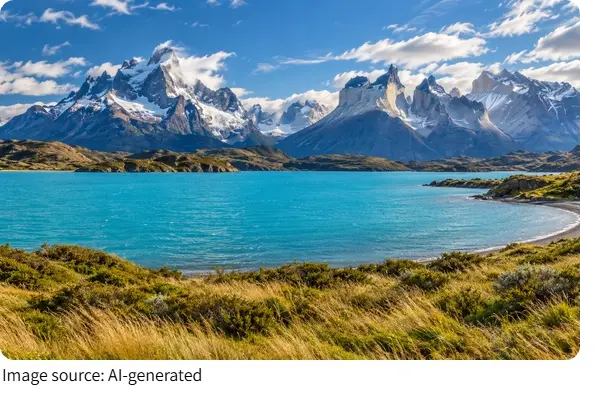
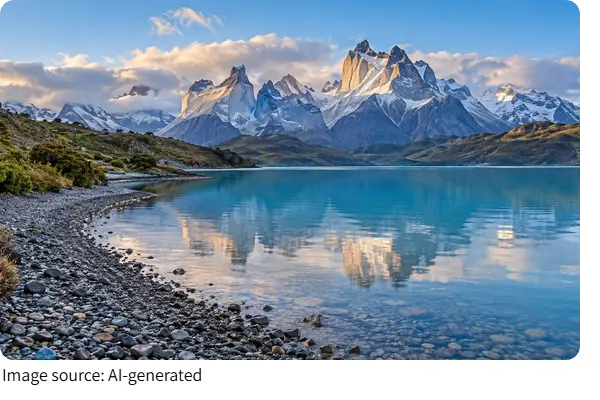
It deserves better than that. This lake sits right in the middle of Torres del Paine National Park in Chilean Patagonia, and the water has a pale green tint that comes from glacial sediment, so you get that color without any filter. You can walk its shore, eat lunch with your boots in the gravel, and watch the Cuernos del Paine rise straight out of the far bank.
Nordenskjöld Lake
Why the color stops you
The green isn't a trick of the light. Fine rock particles, often called glacial flour, hang in the water and scatter sunlight, and the result is that milky tone you see in person. On a windy afternoon the surface goes choppy and the color deepens; on a still morning it goes flat and pale. Either way, the Cuernos del Paine sit behind it, and the two horn-shaped peaks carry a dark band of rock near the top that makes them easy to recognize from across the lake. You'll see that view on a lot of postcards. Standing there yourself is different.
Getting there and getting around
The lake sits along the main road through the park, roughly an hour by vehicle from the Puerto Natales side of the entrance. Most visitors arrive on a day tour from Puerto Natales, which is about two hours away and where the buses and most rental cars start. If you're hiking the W trek, the lake is on your path between Refugio Los Cuernos and the Paine Grande sector, and you'll cross open ground with the water on one side for a good stretch. There's no train, no shuttle inside the park, and no gas station, so plan your fuel before you enter.
From Puerto Natales, buses to the park entrance cost about 8–16 USD one way. A rental car starts at around 50 USD per day, plus fuel. There is no fuel station inside the park, so fill up before you enter.
Where to stay
Most visitors stay in Puerto Natales, where hostels start at around 25–40 USD per night. Inside the park, refugio dorm beds cost about 110–125 USD per person in high season.
Food and costs
In Puerto Natales, a set lunch costs around 8–12 USD and dinner about 20–35 USD per person. In the park, refugio meals cost about 25–29 USD for breakfast, 27–29 USD for a box lunch, and 44–46 USD for dinner.
What to see along the shore
Two things are worth building your stop around. First, the Mirador Nordenskjöld lookout, a short walk from the road pull-off, gives you the full lake with the Cuernos behind it. Second, the Salto Grande waterfall sits nearby where the water drains between two lakes, and the short trail to it takes maybe twenty minutes each way. The wind there is real, so hold onto your hat and your phone. Farther along, the trail toward Los Cuernos follows the shoreline for a few kilometers and gives you quieter views with far fewer people.
Costs and timing
Park entry for foreign visitors runs about 35 USD for a multi-day pass, and day tours from Puerto Natales typically land between 60 and 120 USD depending on what's included. Patagonian weather changes fast, so pack a rain shell and a warm layer even in summer. The park's high season is roughly November through March, when daylight stretches past 9 pm and the trails are busiest. Go early in the morning and you'll have the lookout mostly to yourself.
Before you go
Bring cash for the entrance fee in case the card reader is down, which happens. Fill your water bottle at the refugios rather than drinking straight from the lake. And give yourself more time than you think you need, because the wind slows everything down and the light on the water shifts through the day. A stop you planned for twenty minutes can easily turn into an hour.
Lago Nordenskjöld rewards the people who slow down at it instead of driving past. Next time you're planning a Patagonia day, put this lake on the schedule as a destination, not a detour, and give it the morning.