Beyond Iceland's Ice

ContinentsNorth America

CountriesGreenland

CitiesTasiilaq
Hello, Lykkers! Some places make you feel like an explorer, and Johan Petersen Fjord is one of them. Tucked into East Greenland and branching off the larger Sermilik Icefjord, this narrow waterway is often so packed with ice that boats simply cannot get in.
When it does open up, you are greeted by a world of drifting giants, five glaciers feeding the channel, and the vast Greenland ice sheet looming just beyond the rock walls. There are no hotels, no roads, and no crowds. Here are six sights and experiences worth planning a trip for.
Hann Glacier
The Icebergs Themselves
This is the main event, and it never looks the same twice. The fjord is fed by glaciers that calve ice directly into the water, and the resulting icebergs come in every shape and shade of blue and grey. Some are stranded along the shoreline, others drift in slow herds toward the open sea.
The colour depends on how compressed the ice is, which is why you see everything from white to deep turquoise. Sailing among them is the whole point of coming here. Access to the fjord is typically included in a boat tour or expedition package. Note that AECO zoning lists Johan Petersen Fjord as closed to external vessels, so independent boat access may not be permitted.
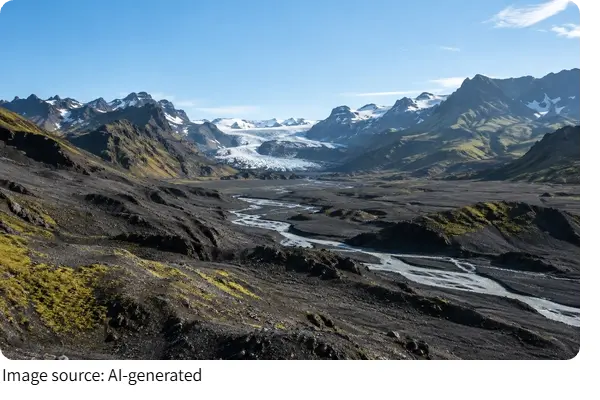
Hann Glacier
Hann Glacier is one of the glaciers that feed the fjord, and it is a favourite stop on small-ship itineraries. You approach by boat and watch the ice wall where it meets the water, listening for the thunder of calving. The glacier is not as famous as some of Greenland's bigger names, but the setting makes it memorable: you are deep inside a fjord that very few people ever reach, with steep rock walls rising on either side. A full-day boat tour from Tasiilaq that includes the Sermilik Icefjord and Hann Glacier is priced from roughly US$1,800–1,850 for a private charter of 1–6 passengers.
The View from Above the Fjord
If you are up for a long hike, the payoff is one of the best views in East Greenland. A full-day climb takes you up to a ridge around 600–900 meters above the water, where the entire landscape opens up: the fjord below, the glaciers feeding it, and beyond them the endless white expanse of the ice sheet stretching inland. It is a demanding walk through polished granite slabs and loose scree, with several hours of hiking. But standing up there, with the ice cap filling the horizon, is the kind of moment that stays with you. Guided hiking is typically part of a multi-day expedition package rather than a standalone purchase.
Helicopter Flight Over the Fjord
If you want to see the fjord from the air without the hike, a helicopter excursion from Tasiilaq offers a different perspective. One operator offers a flight toward Johan Petersen Fjord with roughly 40 minutes airborne and a 15-minute ground stop near the glacier. The price is roughly US$430–440 per person. This is weather-dependent, so build flexibility into your plans.
Inuit Wintering Sites
The shores of Johan Petersen Fjord hold traces of a much older story. An ancient Inuit wintering site sits near the fjord, used until relatively recently before an epidemic devastated the local population. You can still see the ruins of dwellings and graves, some of them weathered open by time and animals. It is a quiet, sobering stop, and a reminder that this landscape has been home to people for generations despite its harshness. Treat these sites with respect and leave everything exactly where you find it. Free to view, though access depends on your tour operator.
Camping on the Edge of the Ice Sheet
This is not a hotel stay. Expedition camps put you in tents within sight of the ice sheet. You fall asleep to the sound of ice shifting and wake up to icebergs stranded at low tide. It is basic, the weather turns fast, and you must prepare for cold and wind. But that remoteness is the whole appeal. Multi-day packages including camping, boat transport, and guiding are the standard way to do this. An eight-day camping and trekking package including Johan Petersen Fjord is listed from around US$2,959 per person (cost may vary widely by operator and itinerary).
Getting there
Tasiilaq is remote and is typically reached by helicopter or boat from Kulusuk Airport. Flights from Reykjavik to Kulusuk take about 2 hours and cost roughly US$400–600 round trip. From Kulusuk, a helicopter transfer to Tasiilaq takes 10 minutes and costs around US$200–250 per person. Once in Tasiilaq, all fjord access is by boat or helicopter as part of a tour.
Where to stay
Accommodation in Tasiilaq is limited to a few guesthouses and hotels, with rooms typically ranging from US$150–250 per night. For the fjord experience, expedition packages include camping or liveaboard stays, with multi-day trips costing upwards of US$2,000 per person.
Food and dining
Dining options are limited to the guesthouses and a small supermarket in Tasiilaq. A casual meal typically costs around US$20–35. For expeditions, all meals are usually included in the package price.
Final Thoughts
Johan Petersen Fjord is not a place you visit casually. It is reached by boat or helicopter from the Tasiilaq area, and access depends on ice conditions that change from week to week. There are no facilities, no shops, and no backup plans if the weather shifts. But for readers who want a genuine Arctic wilderness experience, with icebergs, glaciers, and a view of the ice sheet that few people ever see, this fjord delivers. Go with a reputable operator, pack for cold and wet conditions, and leave your expectations of comfort at home. The reward is a place that feels like the edge of the world.