Secret Beijing Spots

ContinentsAsia

CountriesChina
Hello, Lykkers! Beijing is a city of grand monuments, but its real charm often hides in the quieter corners.
Beyond the Forbidden City and the Great Wall, there are peaceful temples, leafy parks, and creative neighborhoods where daily life moves at a gentler pace.
These six spots offer a different side of the capital, along with practical details to help you plan your visit.
1. Wutasi Temple (Beijing Stone Carving Art Museum)
Wutasi Temple sits just outside Xizhimen, a short walk from the zoo's northwest gate, yet most visitors walk right past it.
The highlight is the Vajra Throne Pagoda, a 600-year-old Ming Dynasty structure covered with more than 1,500 Buddha reliefs. In late autumn, two ancient ginkgo trees turn the courtyard golden, creating one of Beijing's best seasonal scenes. The temple is open Tuesday to Sunday from 9:00 AM to 5:00 PM, with last entry at 4:30 PM. Tickets cost 20 yuan, about US$3, with student tickets at 10 yuan.
The first 200 visitors on Wednesdays enter free with advance booking. The nearest metro is Line 4 or 9 to National Library Station, Exit C, followed by a short walk.
Estimated Cost: US$3 for adults (cost may vary)
2. Zhihua Temple
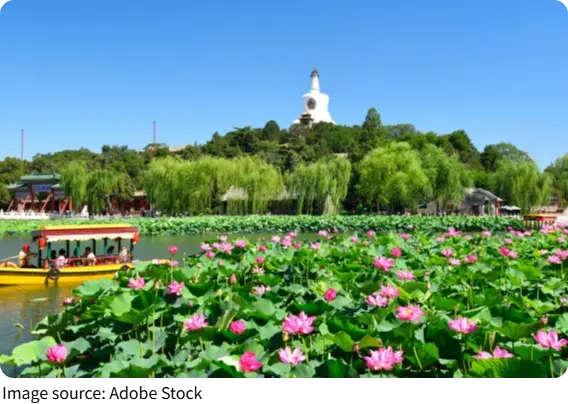
Zhihua Temple is a Ming Dynasty complex hidden in a residential alley near Chaoyangmen. Built in 1444, it features rare black glazed roof tiles and intricate wood carvings. The most unique experience is the daily performance of Zhihua Jing Music, a form of Buddhist chant that has been passed down for over 500 years without changing a single note. Shows run at 10:00 AM and 3:00 PM, lasting about 15 minutes each.
The temple is open Tuesday to Sunday from 9:00 AM to 5:00 PM, closed Mondays. Tickets are 20 yuan, with the first 200 visitors free on Wednesdays. Take Metro Line 6 to Chaoyangmen Station, Exit G, then walk about 10 to 15 minutes through the hutongs.
Estimated Cost: US$3 for adults (cost may vary)
3. Fayuan Temple
Fayuan Temple is the oldest surviving temple in Beijing, founded during the Tang Dynasty in 645. Unlike the city's more famous temples, it maintains a quiet, unhurried atmosphere. The courtyard is home to several resident cats and fills with lilac blossoms in April, making it one of Beijing's top spring flower spots.
Admission is free with no reservation required, though you should bring your ID. The temple is open from 8:30 AM to 4:00 PM, and it is not fixed to close on Mondays. Take Metro Line 4 or 7 to Caishikou Station, Exit D, then walk about 10 minutes through the hutongs. After your visit, the nearby Niujie area offers excellent local food.
Estimated Cost: Free
Fayuan Temple
4. Caochangdi Art District
Caochangdi is a grassroots art village northeast of the city that developed as an alternative to the increasingly commercial 798 District. It hosts edgy galleries and experimental spaces, and many exhibits are free to enter. The atmosphere is raw and unpolished, with artists often present to discuss their work.
The district is best reached by taxi or ride-hailing service, as it sits outside the main metro network. Plan to spend a few hours browsing galleries, and check ahead for opening times as individual spaces vary.
Estimated Cost: Free to explore
5. Wu Dao Ying Hu Tong
Wudaoying Hutong offers the charm of a historic Beijing alley without the overwhelming crowds of Nanluoguxiang. The 632-meter lane is lined with independent cafes, artisan studios, and design shops housed in traditional courtyard buildings. It is a pleasant place to spend an afternoon wandering, with plenty of spots to sit and watch the world go by.
The hutong is easily reached by Metro Lines 2 or 5 to Yonghegong Station, then a short walk. There is no entry fee to explore the lane, and it works well as a low-key stop between larger attractions.
Estimated Cost: Free to explore
Wu Dao Ying Hu Tong
6. Ritan Park
Ritan Park is a free public space built around the historic Altar of the Sun, where emperors once performed ceremonies. Today it is a favorite among locals for morning exercise, chess games, and quiet strolls. The park offers a genuine glimpse into how Beijingers use their green spaces, with ancient trees and a peaceful lake.
The park is open daily from 5:30 AM to 10:00 PM, and entry is free. It is a short walk from Metro Line 6 to Dongdaqiao Station, Exit A. Early morning or late afternoon offers the best light and the most local atmosphere.
Estimated Cost: Free
Final Thoughts
Beijing rewards those who look beyond the obvious. These six spots offer quiet moments, local culture, and a slower pace than the city's headline attractions. Whether you climb the ancient pagoda steps at Wutasi or simply sit by the lake at Ritan Park, you will see a side of Beijing that many visitors miss. Pick one or two, give yourself time, and let the city reveal itself.